
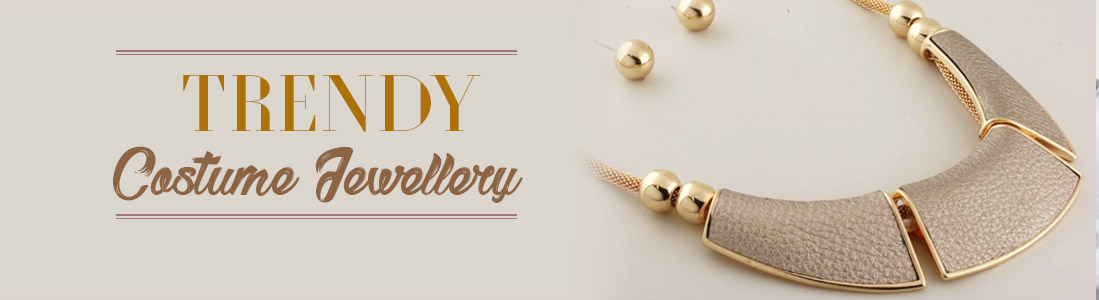
Costume jewelry or Fashion jewelry is available in a myriad of sparkling designs, colors and patterns in the fashion market today. Gone are the days that when jewelry implied gold or silver chains, bangles or earrings. Today the market is flooded with a wide range of costume jewelry, in traditional and contemporary designs, just perfect to complement one's look and style.
Costume jewelry, also known by various names like fake, imitation or junk jewelry, is different from fine or real jewelry, primarily kept as keepsakes, collectibles or investments. Today, ladies costume jewelry is very popular in the market and used for fashion and style, perfect to be worn in formal and regular occasions, parties and social events. Costume jewelry is made of inexpensive materials like wood,glass beads, synthetic stones, bone, brass, terracotta etc. It differs from fine jewelry in the sense that the raw materials used to make fashion jewelry are easily available and economical.
There are innumerable types of costume fashion jewelry. However, the fashion jewelry manufacturers make more designs and patterns of those jewelry pieces that are most popular among women. Some of such costume fashion jewelry types include the following.
Fashion jewelry is almost as old as the human civilization itself. Adornment with various accessories dates back to 3500 BC when women wore jewelry during religious rites. It was a common conviction that jewelry warded off evil, and brought good luck to the wearer. The women of those times made simple jewelry with claws, teeth, and bones of animals.
Later, they began making jewelry from wood, metal, and ivory. They also made jewelry by stringing pebbles onto reeds or jute. Shells were strung together to make necklaces and bracelets. Wire was used to make costume jewelry with simplistic, yet natural designs like animals, flowers, and leaves. Native American jewelry made of primitive beads are popular still today. Other materials used to make jewelry were bird feathers, delicate fish bones, berries, human hair, beetle's wings etc.
Fashion jewelery came to the forefront with the rise of the middle class during the 19th century. Imitations of fine jewelery of the rich gained popularity during this time. Gemstones were replaced with synthetic stones. Foils were used under the synthetic stones to provide a rich glow to pieces of jewelry. Base metals like copper and brass were used instead of gold and silver. Such jewelry was a favorite among the masses because it was not only visually appealing, but also economical.
Costume jewelry represents an all-new fashion trend. Costume jewelry lends elegance and grace to a woman's appearance, besides enhancing her beauty. Today costume jewelery/fashion jewelery is picked so as to match a woman's outfit, and to enhance her personality. It is also used to make a stylistic statement of sorts, reflecting the status, culture, mood, or attitude of the wearer.
Costume jewelry is highly demanded in the market today. Well-known brands and designers like Swarovski, Christian Dior, Coco Chanel and Tiffany have created enthralling costume jewelry pieces. Such jewelry is available in varied designs, styles and price ranges so as to cater to different sections of society.
Initially, costume jewellery was designed to provide common people with affordable jewellery when they could not afford fine jewellery. But today this is also preferred by some of the most famous and wealthy celebrities. In some cases there are costume jewellery pieces that exceed the price of a regular fine jewellery piece. It has found its way into the homes and fashion of many fashionable young women. Costume jewellery is still by far the most affordable jewellery for anyone to buy and hence widely demanded.
Copyright © - Women Fashion Wear All Rights Reserved